I said three words in a training last week and almost laughed out loud in front of the room.
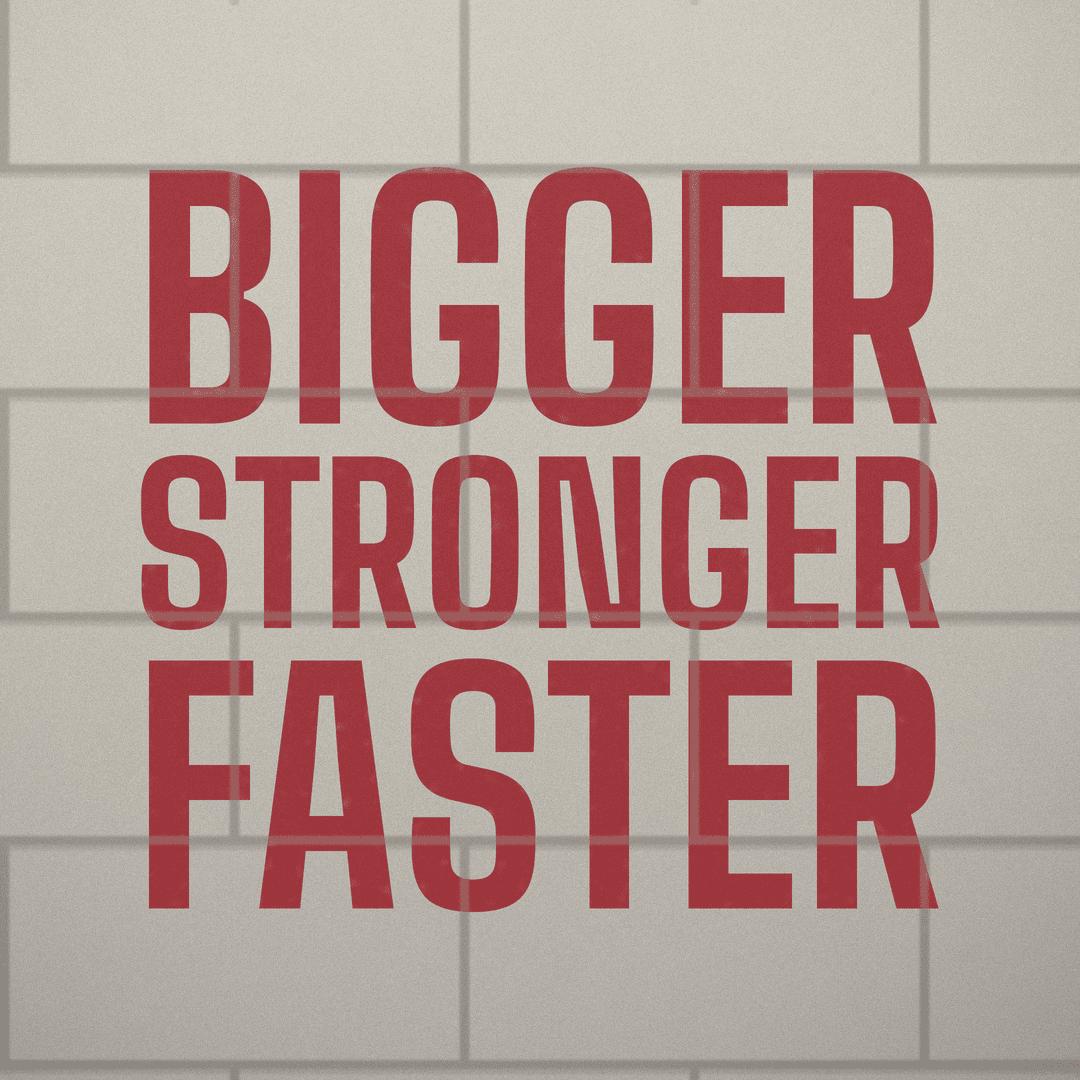
Bigger. Stronger. Faster.
They came out clean, like they were mine. And the second I heard them in the air, I knew exactly where they came from. Not a book. Not a seminar. Not some leadership framework I picked up in my thirties.
They came off a wall.
North end of the junior high gym I played in as a kid. Block letters were painted up above the bleachers, where every boy who ever laced up in that building had to look at them. Three words. No explanation. No small print telling you what to do about it.
BIGGER. STRONGER. FASTER.
I read that wall a thousand times. Warmups. Free throws. Sitting on the bench with a towel around my neck. I read it like it was a promise. I read it like the reading was the doing.
I’m fifty-some years past that gym, and I finally understand those three words. Not because I got smarter. Because I got simpler.
WHAT I ACTUALLY DID WITH IT
Nothing.
I mean that almost literally. I studied it. I turned it over on the bus ride home. I laid in bed and ran it like a tape. And somewhere in an unexamined corner of my thirteen-year-old brain, I believed that if I looked at it hard enough, something would take.
Did I get bigger, stronger, and faster? Sure. I grew up. That’s what bodies do. It had nothing to do with the wall and everything to do with time.
Here’s the thing. At its core, that formula is about as simple as it gets. Bigger means you build capacity—you add to what you can carry. “Stronger” means you apply force where it counts. Faster means you close the gap between knowing and doing.
Build capacity. Apply force. Close the gap. A twelve-year-old could run it.
I didn’t run it. I engineered it.
I asked how. What’s the program? How many days? How much weight? What if I do it wrong? I built a maze out of a hallway.
Then I asked why—and that’s the one that got me. My why just wasn’t strong enough. It wasn’t even a real why. It was “I want to be good. ” That’s not a why. That’s a wound wearing a jersey.
A weak “why” can’t survive a hard how.
THE PART THAT STILL GETS ME
I never asked anybody.
Not one coach. Not one teammate. There was a senior in that building who could squat a house and would have told me everything I wanted to know in about four minutes if I’d walked over and said, “Hey, how do I get stronger?”
There were men in that gym who knew. They were right there. I looked past every one of them and stared at a wall.
I didn’t ask because asking meant admitting I didn’t know. At thirteen, that felt like the most dangerous thing a boy could confess. So I stood at the bottom of a simple staircase and built a machine to figure out how stairs work.
COMPLEXITY IS NOT PROGRESS
Watch how this shows up in a grown man’s life.
Get in shape. Simple. Move your body, eat real food, and sleep. Instead: six weeks of research, three apps, a supplement order, a spreadsheet, and zero workouts. The plan gets more detailed as the man gets more sedentary.
Be present with your kids. Simple. Put the phone down and get on the floor. Instead, read theories about quality time versus quantity time, and a parenting book, so we have a framework for what we could do right now, in the other room, where they are.
Lead your family spiritually. Simple. Open the book. Read it out loud. Pray in front of them, badly. Instead, we wait until we feel qualified.
Ask for help. The simplest one. Six words—I don’t know, can you help? Instead, we build the entire architecture of a life designed to never say them.
See the pattern? The complexity isn’t the obstacle. The complexity is the avoidance. We don’t overthink because the thing is hard. We overthink because thinking is safer than doing, and as long as we’re still working on the plan, nobody can say we failed.
A man stuck in complexity looks productive. He’s got notes. He’s got language for it. He just isn’t moving. And every day he doesn’t do the simple thing, the simple thing gets bigger in his mind.
THE MAN WHO ALMOST WALKED AWAY FROM HIS HEALING
There’s a man in 2 Kings 5 who did exactly what I did at that wall, except his life was on the line.
Naaman, commander of the army of Aram. Decorated. Highly regarded. And covered in leprosy.
He travels to find Elisha, and he does not travel light—horses, chariots, silver, gold, and a letter from his king. This is a man who has thought it through.
Elisha doesn’t even come out. He sends a messenger with a seven-word instruction: go wash in the Jordan seven times.
Naaman goes away in a rage.
Two things set him off. It was too small—he’d already scripted what healing should look like, with ceremony and a personal appearance, something worthy of the trip. And it was the wrong river—the waters back in Damascus were cleaner. He had a better idea. He had his his own formulation.
A decorated commander nearly turned his chariot around and went home to die because the cure was too easy.
And here’s the part I believe God put in there for men like us: Naaman does not figure it out. He has no flash of insight on the road. Left to himself, he dies with a chariot full of gold he never spent.
What saves him is that his servants catch up to him. Men beneath his rank, with no standing and every reason to keep quiet, ask him one question: if the prophet had told you to do some great thing, wouldn’t you have done it? How much more when he just says wash and be clean?
He goes down. He dips seven times. His flesh comes back like a young boy’s.
He had to let another voice into his loop, because his own loop was killing him.
SIMPLE IS NOT SHALLOW
Don’t hear me saying life is easy. The wall wasn’t wrong. Bigger, stronger, faster is a real formula, and the Jordan was a real river.
We don’t distrust simple because it’s weak. We distrust it because it’s exposing. If the answer is that plain, then the only thing standing between you and the result is you. As long as it’s complicated, I have an excuse. The moment it’s simple, I have a decision.
THIS WEEK
Name your wall. The thing you keep researching and rereading and not doing. You knew what it was before I finished the sentence.
Cut it to one sentence. Not a plan. One sentence a thirteen-year-old could repeat back to you. If you can’t get it that small, you’re still hiding.
Ask somebody. Find one man this week who has done the thing you’re stuck on and ask him how. Out loud. A man — not a search engine, not a podcast, not a book.
Because the rage on that road bends when another man speaks.
You don’t need a better formula. You’ve already got one, probably painted on a wall somewhere in your memory.
You need to go get in the water.
🎥 Watch on YouTube: @truemanpodcast 🎧 Listen and find every platform: truemanpodcast.com
About the Author: Mike Van Pelt (“MVP”) is the founder of American Family Renaissance and CEO of True Man Life Coaching. He is a men’s mentor, speaker, author, and podcast host dedicated to helping men reclaim their God-given identity so they can lead strong families and help restore the moral and spiritual foundation of the American family.