Asking for help.
There is a lie that has settled deep into the bones of the American man.
It tells him that carrying the weight alone is strength. That needing someone is a weakness. That a real man figures it out himself or he keeps quiet about the fact that he can’t.
I know this lie. I’ve lived it. And I’ve watched it quietly destroy men who had every potential to be extraordinary fathers, leaders, and examples, men who simply refused to ask for help.
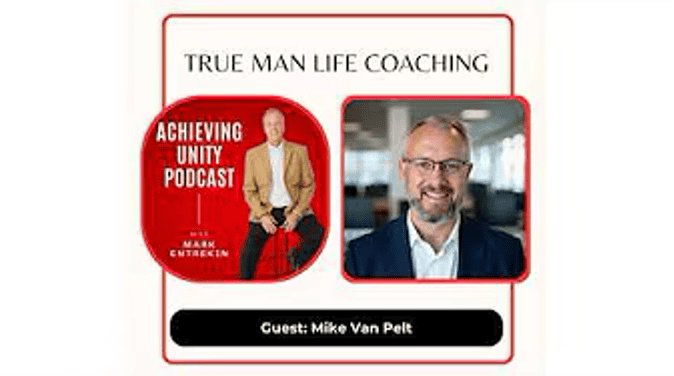
Recently, I had the privilege of sitting down with Mark Entrekin on the Achieving Unity Podcast to talk about one of the most transformative truths I’ve ever encountered, not just in my coaching work but also in my own life:
The power of asking for help is not the beginning of your defeat. It is the beginning of your becoming.
THE BURDEN WE WERE NEVER MEANT TO CARRY
God did not design men for isolation. He designed us for community, accountability, and covenant. When He said in Genesis, “It is not good for man to be alone,” He wasn’t just talking about marriage. He was speaking to something foundational about how men were built to live and lead.
And yet here we are, a generation of men white-knuckling their marriages, their finances, their faith, and their mental health in silence. Carrying burdens they were never meant to carry alone. They perform strength while quietly falling apart inside.
I’ve sat across from men, strong men, accomplished men who hadn’t told a single person in their lives that they were struggling. Not their wives. Not their friends. Not their pastors. No one.
Because somewhere along the way, they were handed a version of manhood that said, “Keep it together, figure it out, and don’t let them see you sweat.”
That version of manhood is killing us.
WHAT ASKING FOR HELP ACTUALLY REQUIRES
Let me be direct with you: asking for help is not simple. If it were, more men would do it.
It requires you to do three things that cut against the grain of pride, and pride is the enemy of almost every man I’ve ever coached.
It requires honesty — the willingness to look at your life and name what’s actually true, not what you wish were true or what you’ve convinced yourself you can manage.
It requires humility — the decision to put down the performance, step out from behind the image you’ve constructed, and let someone else see the real you.
And it requires courage — because vulnerability isn’t the absence of strength. It is a strength under pressure. It takes more courage to raise your hand and say you need help than to pretend for another decade that everything is fine.
David, the man after God’s own heart, a warrior king, cried out to God constantly in the Psalms. He didn’t perform. He poured himself out. He asked. He sought. He knocked.
Jesus didn’t call the self-sufficient to follow Him. He called the honest ones, the ones willing to admit they were sick, lost, blind, or broken.
Asking for help isn’t un-masculine. It is deeply, biblically human.
WHERE GROWTH ACTUALLY BEGINS
In my conversation with Mark, I said something I want you to remember:
Growth begins when we stop pretending we have all the answers and start seeking the wisdom, support, and guidance we need.
Think about every area of your life where you are stuck. Your marriage. Your health. Your faith. Your finances. Your relationship with your kids. Your sense of purpose.
Now ask yourself an honest question: Have you actually sought help, real help, in that area? Have you gone to someone further down the road than you, someone with hard-won wisdom, and said, “I don’t know what I’m doing here? I need guidance.”
Or have you been managing it? Spinning plates? Staying busy enough to avoid sitting with the weight of what you don’t know?
There is a version of you that exists on the other side of that ask. A clearer version. A freer version. A more effective husband, father, and leader.
But he doesn’t emerge through more self-reliance. He emerges through the right support—the right community, the right mentor, the right accountability, and the right surrender to God’s process in your life.
A WORD TO THE MAN READING THIS
If you’re carrying something right now that feels too heavy, I want you to hear this:
You were not built for this alone.
There is no nobility in suffering in silence. There is no reward for a man who dies with his needs unmet and his burdens unspoken. The men who leave the greatest legacies, the ones whose families and communities are marked by their presence, are men who were humble enough to grow, accountable enough to seek counsel, and honest enough to ask.
The American family doesn’t need more men who seem to have it all together on the outside while quietly falling apart on the inside.
It needs True Men. Men who are honest enough to seek God’s help, wise enough to seek the right mentors, and strong enough to admit when they are lost.
That kind of man changes his family.
That kind of man changes his community.
That kind of man helps restore something broken in this nation.
WATCH THE FULL CONVERSATION
If any of this resonates with you, I’d encourage you to watch my full conversation with Mark Entrekin on the Achieving Unity Podcast. We go
deeper into the why behind this message,and into what it actually looks like to take the first step.
BEFORE YOU MOVE ON — ONE QUESTION:
What is one area of your life where asking for help could help you move forward faster?
Don’t just read past that. Sit with it. Write it down. And if you’re ready to take a step, reach out. That’s what we’re here for.
Mike Van Pelt is the founder of The American Family Renaissance and True Man Life Coaching, a speaker, author, and coach dedicated to helping men reclaim their God-given identity so they can lead strong families, live with purpose and conviction, and help restore the moral and spiritual foundation of the American family.